
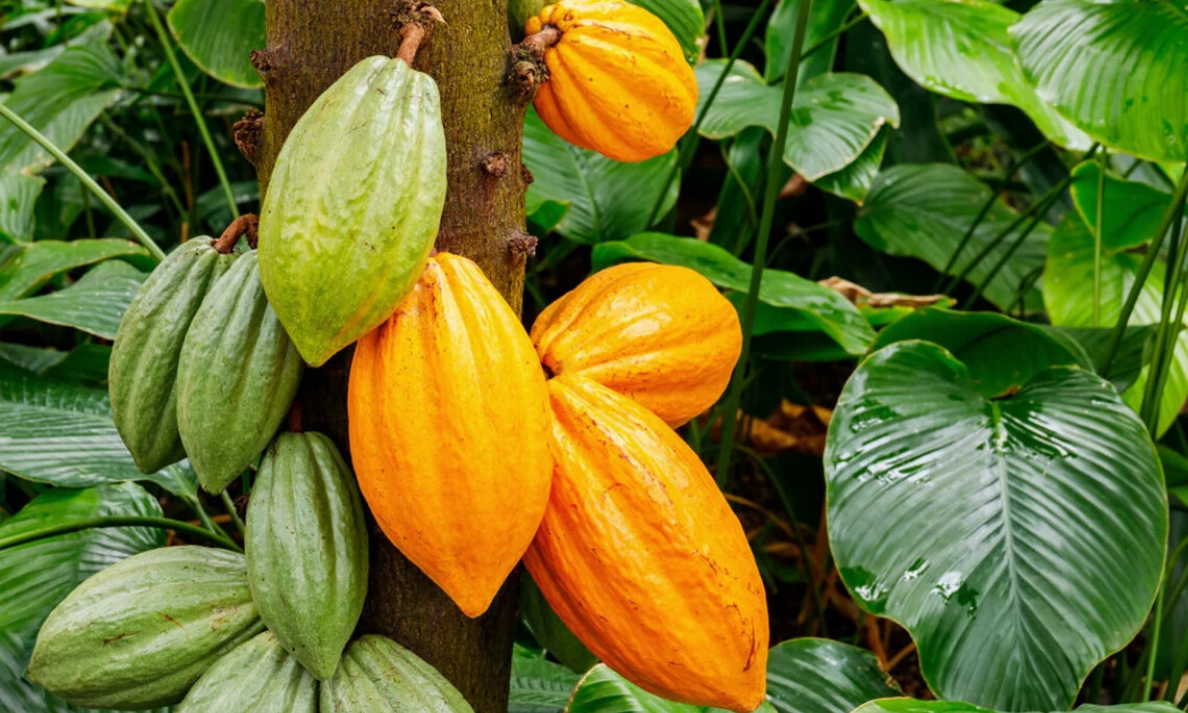
Long before chocolate becomes a bar, a truffle or a beautifully finished bonbon, it begins life inside one of nature’s most remarkable fruits.
For most of us, chocolate starts when we unwrap it.
But its true story begins thousands of miles away, growing directly from the trunk and branches of the cacao tree.
The fruit is called a cacao pod, and inside it are the seeds that will eventually become chocolate.
From Flower to Pod
The cacao tree is an unusual and delicate plant.
Unlike many fruit trees, its flowers grow directly from the trunk and older branches. These tiny flowers must be pollinated before a pod can begin to develop, and only a small proportion of them ever go on to produce fruit.
Once pollinated, the pod slowly grows and ripens over several months.
Depending on the variety, cacao pods can be yellow, orange, red, green or deep purple. Their ridged, almost sculptural appearance makes them look unlike any fruit most people have seen before.
Cut one open and the inside is even more surprising.
Inside the Cacao Pod
A ripe cacao pod contains rows of seeds surrounded by a sweet, sticky white pulp.
These seeds are what we commonly call cocoa beans, although at this stage they bear very little resemblance to the chocolate we know.
Fresh cacao beans are pale in colour and have a bitter, astringent taste. The surrounding pulp is much sweeter, with bright tropical flavours that can sometimes suggest citrus, lychee or mango.
It is here, inside the pod, that chocolate begins—but it is still a long way from becoming something recognisable.
Harvesting by Hand
Cacao pods do not all ripen at the same time, so they are usually harvested individually by hand.
Farmers carefully cut the ripe pods from the tree using knives or long-handled tools, taking care not to damage the delicate flowers and developing pods nearby.
Once harvested, the pods are opened and the beans and pulp are removed.
This work requires skill, experience and close attention. The quality of the finished chocolate is influenced long before the beans ever reach a chocolate factory.
Fermentation: Where Flavour Begins
Fresh cacao beans do not naturally taste like chocolate.
That familiar flavour begins to develop during fermentation.
The beans and their surrounding pulp are gathered into boxes, baskets or covered heaps and left to ferment for several days. Naturally occurring yeasts and bacteria break down the sugary pulp, creating heat and a series of chemical changes within the beans.
This stage is critical.
Fermentation reduces bitterness and astringency while helping to create the flavour precursors that will later become the aromas and tastes we associate with chocolate.
Poor fermentation cannot simply be corrected later. Some of the most important decisions in chocolate making happen here, close to where the cacao was grown.
Drying the Beans
After fermentation, the beans are spread out to dry.
They may be placed on raised beds, mats or large drying patios and turned regularly in the sun. Drying reduces their moisture content, stabilises them for storage and allows flavour development to continue.
The process must be carefully controlled.
Beans dried too quickly, too slowly or unevenly may develop undesirable flavours or become vulnerable to mould.
Once fully dried, they have changed dramatically. Their colour is deeper, their structure is firmer and they are ready to begin the next stage of their journey.
From Farm to Chocolate Maker
The dried cacao beans are packed and transported to chocolate makers around the world.
There, they will be cleaned, roasted, cracked and separated from their shells. The inner pieces, known as cacao nibs, are ground into a thick paste called cocoa mass or chocolate liquor.
Despite the name, it contains no alcohol.
It is simply cacao in its pure ground form: cocoa solids and cocoa butter together.
From there, the chocolate maker can refine the texture, balance the flavour and add ingredients such as sugar, milk powder or additional cocoa butter, depending on the type of chocolate being produced.
Every Origin Tells a Different Story
Just like coffee or wine, cacao is shaped by where it is grown.
Climate, soil, variety, farming practices, fermentation and roasting all influence the final flavour.
Some cacao may taste naturally fruity or floral. Others may have nutty, earthy, caramel or spice notes.
That is why two dark chocolates containing the same percentage of cocoa can taste completely different.
The number on the wrapper tells us how much cocoa is present.
The flavour tells us where it has been and how it has been treated.
More Than an Ingredient
It is easy to think of chocolate as something created entirely in a kitchen or factory.
In reality, every bar begins with agriculture.
It begins with farmers tending fragile trees in tropical climates, harvesting ripe pods by hand and carefully managing fermentation and drying.
By the time chocolate reaches us, it has already passed through many hands and travelled an extraordinary distance.
Understanding that journey changes the way we taste it.
Chocolate is no longer simply a sweet treat.
It becomes the result of nature, skill, time and human craftsmanship.
And it all begins inside the cacao pod.